
QA & Testing Services
QA Consulting
Equipped with some of the most experienced QA professionals found anywhere, we are the most dependable and most reliable choice for consultations on QA processes, IT Infrastructures, project documentations, etc. We carry out relevant appraisals, interviews, and other forms of examinations to help ascertain the specifics and peculiarities of the project at hand, as well as identify Quality-Assurance-related risks.
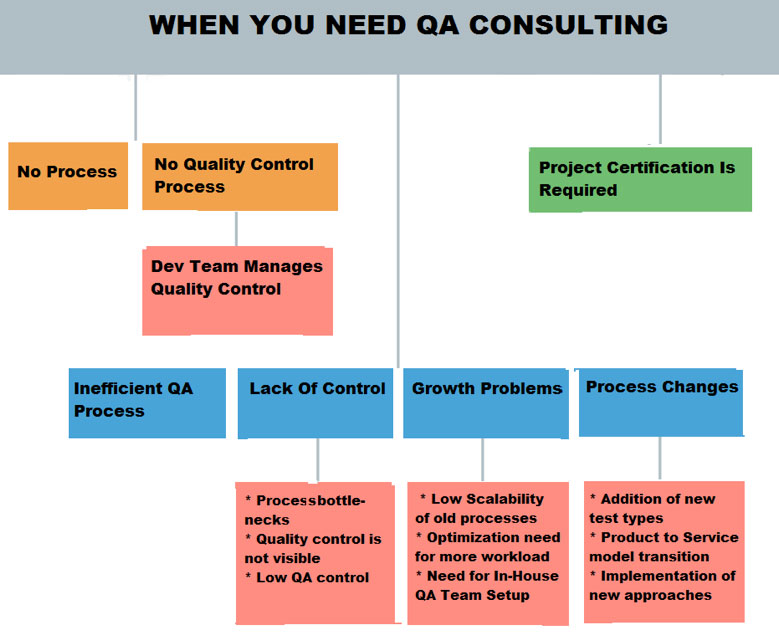
Models
We are equipped with the human resources, intellectual know-how and exposure to address any form of QA challenges.
Our deep-rooted and meticulous approach to addressing consultation needs is an asset that guarantees lasting solutions to our client organizations.
Consulting Processes
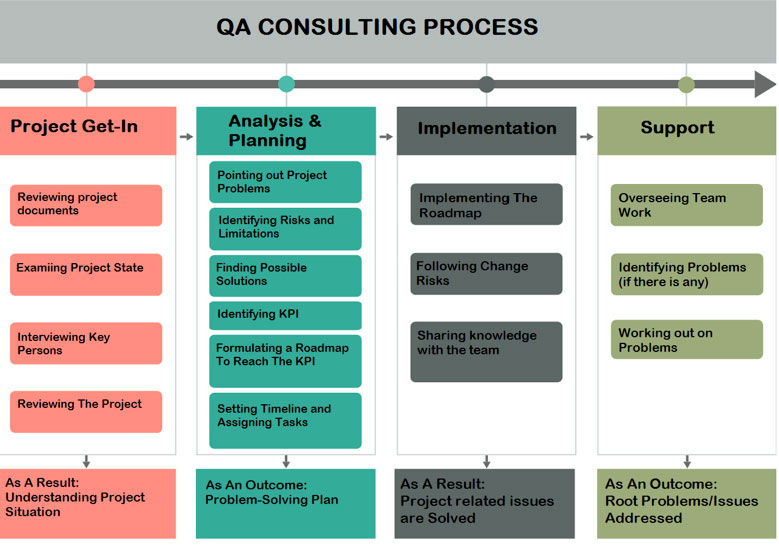
We begin by critically investigating and exploring the challenges at hand with the most applicable methods and the consideration of relevant data. We thus come up with a specific and lucid approach towards addressing the client’s projections from the status-quo.
At this stage, with our picture of the challenges, we engender an idea of the most suitable way to get started. Also, with our conceptions of the challenges at hand, we carry out a verification of our results in the earlier stages. This helps us in ensuring that our projected plan is the most suitable for the set-goal. Then, based on our observations, we prepare a detailed collaboration roadmap that is specifically designed to guide us towards the actualization of set-goals.
Here we synchronize the data available to us by giving it a perspective. We also take deliberate steps to work with the client organization(s) towards achieving congruence in our patterns of operation.
At this juncture, we take relevant steps in the execution and implementation of every strategic information available to us, constantly and transparently carrying the client organization(s) along. However, our steps are meticulously and painstakingly taken.
Here, having carried out our plans, projections and having appraised the result, we either improve on the implementations or address other recurring challenges.
Results
Over the years, in our operations across different fields, we have achieved effective results. This has earned us stupendous reviews.
Why QA Outsourcing?
Given our rather customer-focused approach and our unconventional principle of maintaining and promoting our client organizations’ visions, we are the suitable choice for every both start-ups and experienced organizations. Our legacy of meticulous and quality outsourcing also makes us the best choice to address every delicate technical and organizational hitches.
What we offer?
With a consistent culture of first class service provision through the years in QA Consulting, software testing, and a host of other services, we outsource some of the most exposed and competent bodies who specialize across different fields. Also, being equipped with the excellent top-class facilities, our clients can be sure get top-notch services.
Types of testing and tools
We offer a wide range of manual and automation testing services. Some of them are highlighted below:
Mobile testing
Accenture can implement and run the tools required to support Continuous Delivery and DevOps.
Migration testing
Accenture can implement and run the tools required to support Continuous Delivery and DevOps.
Acceptance testing
Accenture can implement and run the tools required to support Continuous Delivery and DevOps.
Platform testing
Accenture can implement and run the tools required to support Continuous Delivery and DevOps.
API testing
Accenture can implement and run the tools required to support Continuous Delivery and DevOps.
Usability testing
Accenture can implement and run the tools required to support Continuous Delivery and DevOps.
Network testing
Accenture can implement and run the tools required to support Continuous Delivery and DevOps.
Web services testing
Accenture can implement and run the tools required to support Continuous Delivery and DevOps.
Functional testing
Accenture can implement and run the tools required to support Continuous Delivery and DevOps.
Security testing
Accenture can implement and run the tools required to support Continuous Delivery and DevOps.
Compatibility testing
Accenture can implement and run the tools required to support Continuous Delivery and DevOps.
We have a range of modern testing tools, with a number of them specifically meant to satisfy the varying needs of clients. A few are
Selenium
Accenture can implement and run the tools required to support Continuous Delivery and DevOps.
Appium
Accenture can implement and run the tools required to support Continuous Delivery and DevOps.
RanorexWatir
Accenture can implement and run the tools required to support Continuous Delivery and DevOps.
Katalon Studio and others.
Accenture can implement and run the tools required to support Continuous Delivery and DevOps.
Co-operation Models
Given our customer-focused ideals, our priority is the quality and plainness of our developmental processes. It is to this end that we make use of the most effective co-operation models for our clients.
Accenture can implement and run the tools required to support Continuous Delivery and DevOps.
Challenges
We are primarily faced with the general challenges peculiar to testing services and outsourcing within the field of technology. Some of them are:
Some level of difficulty of relating with the business domain and operations of some clients.
The differences in language and socio-cultural perspective between our team and our clients.d
Accenture can implement and run the tools required to support Continuous Delivery and DevOps.
Affordability
Advantages
Some advantages of working with us include:
Learning opportunities.
Lower costs
Access to the suitable skills and resources
Transparency of operations
Our services comprise a wide-range and all-encompassing testing components and other relevant media. They include test automation planning, tool selection, the maintenance of a test automation environment, implementation of automated test, data preparation, etc.
Automation Offerings
Our test automation services are particularly distinct due to the unusually stupendous quality and comprehensiveness of our test automation solution.
Apt test environment setup and configuration: We have a legacy of cultivating the most suitable environment for the purpose of tests.
Automated UI testing with the best tools: We have a great deal of experience in writing and designing of test cases as well as the capacity for maintaining scripts for effective automated checks of new features and the testing for regression via UI.
Automated test dada generation: We have an automated compilation of all forms of data for both automated and manual tests.
Test automation strategy development: With a very sound consciousness of the best software development approach, the QA and deployment realities, we build the ideal test automation strategy.
API testing: With the use of tools like JMeter, Postman, etc., we come up with excellent test cases, developing and maintaining scripts to help us the efficient examination of the software features via the use of API and check integrations.
Migration of test scripts from other platforms: We migrate test scripts developed from other platforms to Selenium to unify test automation tools.
Implementation of CI/CD pipeline: We design and implement the continuous integration pipeline in collaboration with the DevOps. The essence of this is to help you deliver new app features faster and even more effectively without compromising quality.
Our Cooperationd
Discovery
Examine the current QA processes
Prepare a plan for test automation process
Review the current IT infrastructure architecture
Transition
Transfer knowledge or do knowledge mining
Set up test automation process
Develop test automation strategy
Help to enhance QA process so as to integrate test automation into it.
Adjust the test automation service plan if there is need for it.
Transfer responsibility
Build-up the test team.
Service Delivery
Develop and maintain tests
Come up with test cases and design test data
Structure the test environment
Evaluate the progress and give report
Service Evolution
Implement forefront testing techniques.
Liaise with the development team for a much more effective risk-based testing.
Further increase the rate of test automation at appropriate places
Collect feedbacks from development managers, leading to improved coverage, test granularity, defect description.
Optimize CI, in collaboration with –DevOps teams.
Advantages of Manual Testing
It is much more affordable since there is no need to spend on automation tools and process.
It gives quick visual feedback.
Here, the user doesn’t have to change the entire code before making little changes in the app.
Human intuition and reasoning is at play in manual testing. This leads to more effective results and outcomes.
Manual testing gives an exact replica of the real user experience on web and mobile applications.
It minimizes errors or loopholes.
It is applicable to both big and small projects.
Services We Offer under Manual Testing
System testing
Compatibility testing
Test case creation Activity
Cross-browser Testing
Multiplatform Testing
Software Product testing
W3C/HIG Compliance testing
Manual Testing is Most Effective For
Exploratory testing: This test is mostly applicable for poorly prepared specification documentation or one that has to be completed within a short period of time. Exploratory testing doesn’t require much planning but most test execution. It affords the tester the opportunity to learn while going through the process. Hence, foreknowledge isn’t compulsory.
Usability testing: This test helps the tester examine and observe how usable, user-friendly or efficient the product will be to the end-users. Its primary aim is to ensure that the product is able to serve its purpose with its target users.
Ad hoc testing: This testing is performed without any plan or documentation. Hence, its results depend on the skill of the tester(s). A difference between the ad hoc testing and the exploratory testing is that the exploratory testing requires some documentation (Ad hoc doesn’t). Also, ad hoc is an informal testing, while exploratory is formal.
Mobile Testing
Apps We Test
Mobile apps
Mobile web apps
Mobile Testing Services We Offer
Usability testing: By testing the usability of your apps: its user-friendliness UI, encompassing key functions, engaging UX, etc., we ensure that the product is not only running smoothly, but captivating, attractive and easy to use.
Mobile performance testing: Our team ensures that your app is well tested in the areas of the weak signals, interference from other devices, excessive load, etc. to ascertain if the app is free stress, scalability and reliability bugs.
Mobile functional testing: Here, our team will ensure that your app is fully and perfectly functional and able to effectively meet the needs of its intended users.
Mobile Compatibility testing: The essence of this is to ensure that the app maintains its 0right functions and works hitch-free on target-devices.
Compliance testing: Since mobile apps are now found everywhere and almost occupying every field of human endeavor, there is the need to ensure that an app meets industry standard. Our exposure, knowledge and experience come to play here. We test your apps for compliance standards in line with the iOS and Android guidelines.
Mobile Security testing: This is very important since there has been an increase in hacking attacks. We test the capacity of your apps to withstand hacking attacks. With ethical hacking, our team will test how free it is from loopholes. For larger apps, we ensure the security of the server side.
Approach to Testing
Analyzing project requirements: We’ll study the requirements of your projects and check if it has any loophole.
Selecting devices and planning the processes: Here, we ensure that carry out a statistical appraisal of devices, based on the app requirements and make recommendations towards the achievement of the set-goals.
Design test cases: Here, we draft the appropriate test cases.
Testing: Our team test the applications and report the challenges.
Analyzing test results: Here, our team comes up with a deep analysis of the test results and provide d hoc information on it.
Challenges we solve in API testing
Alternating or changing requirements: We efficiently respond to solving the challenges of changing requirements and ensure that the set-date for release isn’t surpassed.
Device fragmentation and Usability: From our testing laboratories and with the devices provided by our clients, we efficiently address the fragmentation challenge, thus ensuring wide coverage on popular platforms.
Lack of all-round collaboration: We work assiduously towards ensuring the horizontal cooperation with stakeholders designers, developers, and to see to it that they are constantly intimated.
Lack of domain knowledge: With our exposure to different industries and domains, we ascertain if an app is faulty or free from industry-specific pitfalls and security issues.
Advantages of API testing
Significantly reduces the amount of time used for functional testing. This can be attributed to the use of standard procedures that enable the test process to be automated and hence take less time
Check and decrease costs that can be incurred with manual testing. Manual testing has a heavy requirement for time and financial resources to facilitate rigorous API testing. Using an automated procedure should significantly reduce these costs.
Monitor the overall strength of a particular build. By using a graphical user interface, many areas can be thoroughly monitored during testing and hence provide a well detailed test to improve the strength of a particular build
The accuracy of each test can be checked and improved seamlessly. The test results are documented accordingly hence can be used as reference when improving a build.
Easily integrate graphical user interface tests. End-to-end API testing enables real-time testing on a graphical user interface.
Ability to perform different functional tests including code-level functionality. This enables the discovery of unused or non-functional code that can be effectively eliminated to improve performance.
API testing is used in conjunction with automated/manual and development testing. API testing is not a secluded entity, it can be resourcefully used with other testing types to produce much better and desirable results.
How we resolve common issues
Designing desirable test cases with the end-user in mind. This does not limit the scope of a test but ensures that relevant information is found from the test
Employing the best test techniques. This includes the use of techniques such as equivalence classes, boundary value analysis and error guessing
Testing according to how we expect the API to be used. It is only possible to test the most likely usage scenarios since the scope of usage can be very wide.
Choosing a suitable framework. The makeup and areas of coverage of the testing framework is well defined. Ideally, selected frameworks support GUI tests.
Making the team to become deeply familiarized with the API. Our teams spend plenty of time with each API in order to understand all its components before testing
Types of performance testing services offered
Load testing
We test whether the system can handle different load variations. This helps to determine the number of connections the system can manage at a given time. Load testing also enables the detection of problems within the system and what causes them.
Stress testing
We test the maximum capacity the system can handle during operation then figure out whether the system will run efficiently if the load exceeds its maximum expected capacity.
Stability testing
We also test whether a system maintains stability over an extended period of time (including daily operation). This helps to distinguish and plan for system downtime.
Scalability testing
We measure the ability of a system to scale when large loads are applied. This is useful in determining at which point the system stops scaling and why it stopped scaling.
Tools we use
Apache JMeter: An open-source java-based application that is designed to test functional and performance behavior. It can test a myriad of applications including web applications.
Microsoft Visual Studio: The web performance and load testing component is an important tool that can be used to test and display a detailed summary of an application’s performance.
HP LoadRunner: This is a software testing tool that can simulate thousands of users concurrently using an application.
Benefits of using our performance testing services
We help you avoid an expensive system redesign due to issues related to performance
We enable you to plan and release your system on time
By improving your system's performance you ensure your customers are satisfied
We enable you to fix the existing problems that lower the performance capability of your system.
You get important information about your system's performance strength which can be used to plan for future activities.
Our performance testing services help increase employee productivity
Recommendations for successful performance testing
Prepare your environment and application by ensuring required resources are well in place before testing commences
Define your goals clearly. You should clearly define metrics such as peak response time, average response time, requests per second and error rates.
Set up a similar environment. Your test environment should be similar to your production environment.
Perform relevant tests that are well thought out and related to use cases.
Different services we provide
UX research
We offer important information that may be unavailable in prior UX design.
Our UX research includes:
User research - We gather the needs and problems of your target audience.
Persona creation - We build personas of potential users.
Scenario creation - We investigate how users can use your solution to solve their problems.
User journey mapping - We illustrate all points a user comes across when using your application
UI prototyping - We create a prototype to illustrate logic and functionality.
UX audit
We detect interactive pain points, performance issues, and UI defects and review information architecture; then prepare recommendations.
Our UX audit includes:
Discovering the main scenarios of user behavior
Checking navigation and solutions structure
Detecting issues with design on web usability
Usability testing
We assess how clear and easy your application’s usability is to end users.
Our usability testing includes:
We assess how easy it is to navigate your app
We test determine whether a user can complete different scenarios using your application
We assess the arrangement of GUI elements
Challenges we solve
No usability design – We model users with real problems, needs and expectations from software and map the journey of created personas on your application.
Different domains have different usability requirements – A given application can have users from different domains such as banking, manufacturing, healthcare or retail. We walk in different users’ shoes to understand their real needs.
Different users have different usability requirements – We test the application’s convenience to different users of the app.
Usability testing can be ineffective without producing real-life context – We reproduce real-life usability testing on different devices in different settings that your audience is likely to use your application.
It is difficult to establish the best order of fixing when many issues have been identified – We not-only point out usability problems but define a degree of severity to identified issues in order to focus on impactful aspects. We also establish the most convenient order to fix issues and ensure updates to an application’s usability components won’t cause new ones.
Techniques and methodologies used
Expert-based usability testing through
– Heuristic evaluation
– Cognitive walkthrough
User-based usability testing whereby members of the target audience use a prototype to complete scenarios developed by a UX researcher.
Penetration testing services – We test different security vulnerabilities including:
Cross-site scripting
SQL injection
Cross-site request forgery
HTTP response spitting
App level testing services
Availability testing
Authorization testing
Non-repudiation testing
Authentication testing
Integrity testing
Testing DDoS and DoS vulnerabilities
Storing too much data in sessions
Consuming the disk
User input as a loop counter
DoS buffer overflow
DoS lacking customer accounts
DQL wildcard attacks
Security code review
Define a process to perform code review
Identify vulnerabilities
Find incorrect or poor coding techniques
Identify security issues specific to application domain
Our security testing experts can help you:
Reveal problems that develop from the interaction between your application and the rest of your IT infrastructure
Identify security vulnerabilities from implementation errors
Expose design flaws in the security model of your application
Use different manual techniques to evaluate your application's security in real-world attacks
Build the trust of your application's users with increased overall security
Types of penetration tests
Black box testing – We work in real-world conditions having little knowledge about your network structures, network protection, security policies and software used.
Grey box testing – We examine your system equipped with information about your network such as architecture diagrams, network overview or user login information.
White box testing – We identify potential weaknesses by accessing server configuration files, using admin rights, database encryption principles, source code and architecture documentation.
Phases of generation tests
Resolution and re-testing phase
Pre-engagement action phase
Reconnaissance phase
Threat modeling and vulnerability identification phase
Exploitation phase
Post-exploitation phase
Reporting phase
Benefits of security testing
Security testing explores weaknesses in a given system
Identified vulnerabilities can be fixed
Enables detection and response to attacks on time
Your system will be able to run 24/7 by identifying and avoiding disruptions
A report by a third-party expert has a bigger impact
Industry and legal requirements may dictate a level of penetration testing
A company known for its strict and systematic security reviews will have its stakeholders resting assured
Deliverables of Security Testing
Executive summary: A summary of the tests undertaken on the application and their results
Scope: The areas the security test covered
Findings: The relevant information derived from security testing
Evidence: A detailed explanation of the issues identified
Tools and methodologies: A guide on techniques, software and hardware used to perform the security tests
Releasing a product without rigorous testing can be accompanied with many risks. We offer end-to-end functional testing services that make sure your application operates in the way it was intended, in compliance with business needs and all functional requirements.
Functional testing services we provide
Smoke testing
Sanity/regression testing
User acceptance testing
Integration testing
Module/unit testing
System testing
We provide both automated and manual testing services.
Application types we test
BI and big data solutions
Web portals
IoT solutions
Customer Mobile Applications
Enterprise mobile applications
eCommerce solutions
Enterprise applications (ERP, CRM, SCM, BPM, billing systems and so on)
We guarantee compliance with GDPR and secure authorization and protection of sensitive data.
Different models of testing
Our functional testing services are provided under three cooperation models:
Team augmentation - Your testing team is strengthened by our testing specialists
Managed testing services - Our testing team takes up all testing activities
Setting up the testing team - An independent testing team is set up Use of methodologies
Agile family:
Scrum and customizations
Waterfall family:
Iterative development
V-model
Customized RUP
Waterfall
MSF
We are highly flexible so our team is ready to:
Follow the best methodologies recognized by your company or the industry in general
Set up the process that best addresses your requirements
Our approach to functional testing
The testing process has three main stages:
1. Requirements analysis and clarification
Our specialists smoothly integrate with your project team.
The outcome of the initial stage is a dive into the project scope and specifics and drafting the test strategy.
2. Test planning and test design
Drafting test plan: The test lead drafts a test plan that is reviewed and approved by stakeholders.
Test design: A test case document is prepared.
Prep measures: Our testing team develops a well-balanced strategy.
The outcome of the second step is a test plan, test case, test environment and test data.
3. Stabilization
The third stage involves the following
Defect validation
Test reporting
Defect reporting
Test execution
Regression testing
The outcome of the third stage is a test summary report.
Reporting and bug tracking
Our team uses the best bug tracking and task management systems such as:
Rotational Clear Quest
Atlassian Jira
Logigear Track Gear
HP Quality Center
Bugzilla
Salesforce testing can help in finding out how well your customized features work and testing business changes so you can be more confident in the final result. Salesforce testing is important because it:
Tests quote contexts for correct product pricing
External APIs can be validated
Enable validation of permissions and access
Increases test coverage
Ensures good functionality with environment integration testing
Reduces business risks for testing customizations
Enables customizations with improved stability
Enables correct pricing of products
Benefits of Salesforce testing
The testing window is expanded to 24/7 without addition of new resources
Problematic components are isolated during the earlier phases in the lifecycle of software development
Problematic components are isolated during the earlier phases in the lifecycle of software development
Testing for patches and more releases of software is increased within stipulated timeframes
Reduces the time taken before release to market
Helps to increase customer confidence and reduces the number of defects during production
The testing process is improved/enchased and made more effective
Reports are straight-to-the-point and reduced in length
Enables end-to-end regression
Releases made later can reuse test cases of earlier releases
Formalizing processes enables standardization within the organization
Delivers improved test accuracy
Facilitates the identification of defects earlier
Enables wider test coverage to ensure crucial aspects are tested before releasing the application
Enables a rigorous, effective and faster execution process
Significantly reduces the risks for a business
Optimizes the process followed when releasing an application
Takes maximum advantage of important stakeholders
Testing departments are matured by enabling a continuous integration process
Phases of Salesforce testing
Requirement analysis – Business requirements are distinguished then a scope analysis of user stories is performed
Backlog refinement
Test case design - Your team approves the test cases which are then evaluated for coverage
Test plan - The test plan is prepared then risks and mitigation actions are identified
Setup and executions - Test data is created before users are assigned permissions UAT testing and deployment - The test cases are executed then a report is prepared. Finally the system is deployed for production.
Results
At the end of the Salesforce test a detailed report containing the details of new features is provided. The regression test suite is executed and finally a report is submitted.